Age grading
Checks whether the product stage, warning language, and supervision expectations match the way a family will actually use the item.
Vtech safety content is written for the moment when a parent, retailer, or product reviewer asks what sits behind an age label. The page translates toy and baby technology checks into practical review areas: material screening, small-parts logic, battery handling, labeling, digital setup, and the standards language buyers expect to see before purchase.
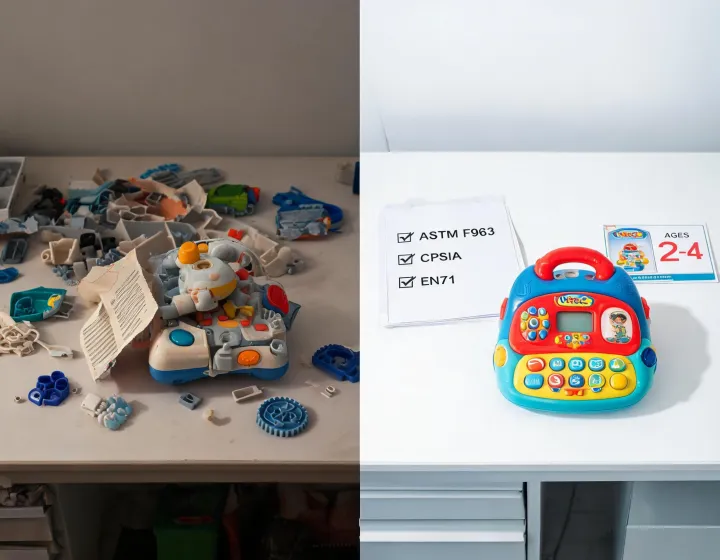
This dashboard uses the shape of a calculator without pretending that safety can be reduced to one score. The purpose is to show how Vtech separates the review inputs. A squishy or fidget product raises material and labeling questions; a kid smartwatch raises battery, charging, and setup questions; a baby monitor raises reliability and household-use questions. Each category receives a different path.
Checks whether the product stage, warning language, and supervision expectations match the way a family will actually use the item.
Looks at BPA-free expectations, non-toxic claims, soft materials, coatings, and parts that may be mouthed, squeezed, bent, or cleaned repeatedly.
Reviews battery compartments, seams, switches, charging notes, durability points, and any interaction that could confuse adult setup or child use.
Confirms that product pages, packaging, and support routes use consistent standard references and do not bury important limitations.
| Reference | Where it helps | Buyer-facing explanation |
|---|---|---|
| ASTM F963 | US toy safety framework | Used to discuss physical, mechanical, labeling, and use-context expectations for toys. |
| CPSIA | US consumer product compliance | Supports material and children product compliance conversations for retail review. |
| EN71 | European toy safety reference | Relevant when products are compared across international retail or distributor requirements. |
| BPA-free and non-toxic notes | Material reassurance | Helps families understand why material language differs between baby care, soft play, and electronic toys. |
Vtech does not apply one generic safety paragraph to every product. Families compare risk differently when they are looking at a baby monitor, a STEM toy, or slime and fidget play. The following examples show how the review emphasis shifts while the overall safety-first posture stays consistent.
Response emphasizes setup reliability, power guidance, household placement, product registration, and support escalation because the product sits inside a daily care routine.
Response balances learning objective, age grading, battery compartment access, button durability, and labeling so the recommendation stays developmentally appropriate.
Response focuses on material feel, cleaning expectations, non-toxic positioning, supervision notes, and the difference between trend appeal and age-safe use.
Share the product family, target market, and review need. Vtech can route the request toward material notes, labeling context, or retailer documentation support.